
Last Updated: November 14, 2026
Quick Summary
Solar panel cleaning is worth it when the value of recovered production beats the cleaning cost, so run the break-even math for your own array. Cleaning rarely pays on small arrays, after recent rain, or when the output dip is really a system fault.
- Multiply monthly production by your soiling-loss range and your electric rate to get the recoverable dollar value.
- A 6 kW array losing 2% to 5% at $0.15/kWh misses only about $2 to $5 a month.
- Rule out weather, inverter alerts, and new shading before paying anyone to clean.
- Most homes do well with one cleaning a year, after pollen season and before summer peak production.
- Verify a company is licensed, bonded, and insured, and get a flat written quote before booking.
Table of Contents
- Is Solar Panel Cleaning Worth It? The Break-Even Math
- What Solar Panel Cleaning Cost Really Looks Like
- How Often to Clean Solar Panels in a Dusty, Four-Season Climate
- How to Clean Solar Panels Safely Without Voiding the Warranty
- Finding a Solar Panel Cleaning Service Near Me: What to Verify
- Request an Estimate for Solar Panel Cleaning
- Frequently Asked Questions
Is Solar Panel Cleaning Worth It? The Break-Even Math
Whether solar panel cleaning is worth it depends on one number: how much dirty panels cost you in lost electricity compared with what cleaning costs.
Here is the short version. Cleaning pays when your panels are visibly coated, your electric rate is high, and your array is large enough that a small efficiency loss adds up to real money.
The U.S. Department of Energy solar energy basics notes that panel output depends on how much sunlight reaches the cells. Dust, pollen, and bird droppings block that light.
How to Run the Numbers for Your Array
You need four inputs. Write them down before you decide anything:
- System size in kilowatts (kW). This is on your contract, your inverter label, or your monitoring app’s system profile.
- Your electricity rate per kilowatt-hour (kWh). Check the supply and delivery lines on your utility bill. If you are on a time-of-use plan, use the rate that applies during your solar production hours.
- Recent production in kWh. Pull the last full month from your inverter app or monitoring portal.
- An honest soiling-loss estimate. Light dust film costs a few percent of output, while heavy buildup after a dry, windy stretch, nearby construction, or a tree drop can cost noticeably more. Use a conservative range rather than a single guess.
Now do the arithmetic. Multiply your monthly production by the low end of your loss estimate, then by the high end. Multiply each result by your rate. That gives you a dollar range for what cleaning could recover in a month.
Example with round numbers: a 6 kW array producing 700 kWh in a month, at a $0.15/kWh rate, with a 2% to 5% soiling loss, is missing roughly 14 to 35 kWh, about $2 to $5 that month. A single $150 to $300 cleaning does not pay back on that math. Scale the same logic to a 12 kW array producing 1,400 kWh, or to a higher rate, or to heavier soiling, and the recovered value climbs fast. The point is not the exact figure; it is that the figure changes the decision.
If cleaning costs more than the lost production it recovers over the interval before soiling returns, wait. If it costs less, schedule it. That is the whole break-even test.
Separate Soiling From a System Fault Before You Pay Anyone
A production dip is not automatically dirt. Before you book a cleaning, rule out the cheaper explanations:
- Compare against weather. A cloudy month lowers output with no soiling involved.
- Check inverter alerts and error logs. A derated string or a tripped breaker looks like lost production but cleaning will not fix it.
- Look for new shading. A growing tree, a new rooftop addition, or debris on a single panel can cut output more than uniform dust.
- Review historical output. If the drop is seasonal and matches last year’s pattern, it is probably not soiling.
- Inspect visually from the ground. Chalky film, pollen streaks, and bird droppings are soiling. Cracked glass, discolored cells, or hot spots are not.
Watch out: paying for a cleaning to fix a production problem that is actually an inverter fault or new shade wastes the cleaning fee and delays the real repair. Confirm the cause first, then decide.
What Solar Panel Cleaning Cost Really Looks Like
Professional solar panel cleaning cost depends on your array size, roof pitch and height, access, and how much buildup has collected. A steep two-story roof takes more time, more safety equipment, and often a lift or extended pole than a low garage array.
Pricing depends on these factors, so request a quote from Salt Lake City Window Cleaning on its website for current prices.
What Should Be in a Cleaning Quote
Ask for a flat written quote before anyone climbs up, and confirm it covers:
- The visit and labor for the full array, not a per-panel surprise once the crew arrives.
- **
- Access method, ground poles, ladder, or lift, and who is responsible for roof safety.
- **
- A method that matches your panel maker’s guidance, so the cleaning does not create a warranty dispute.
DIY Cost Versus Professional Cost
DIY cleaning cost is lower on paper, a soft brush, a hose, and your time, but it carries its own price: ladder time, roof risk, and the chance of scratching glass with the wrong tool or leaving hard-water spots with unfiltered tap water.
| Approach | What You Pay For | Main Risk | Best For |
|---|---|---|---|
| DIY, ground-level reach | Soft brush, hose, filtered water, your time | Ladder falls, scratches, spotting | Single-story, low-tilt arrays |
| Professional cleaning | Flat per-job quote | Almost none if licensed and insured | Two-story roofs, steep pitches, heavy soiling |
| Skip until rain | Nothing | Gradual output loss | Small arrays, rainy seasons |
Water Use, Runoff, and Local Rules
Cleaning uses water, and where you live matters. In drought-prone areas, check whether local water restrictions limit outdoor use, and ask a provider how they minimize runoff.
Watch out: a quote that seems low because it skips insurance, filtered water, or a method that matches your panel maker’s guidance can cost more later in liability, spotting, or a warranty dispute. Compare quotes on what they include, not just the bottom line.
How Often to Clean Solar Panels in a Dusty, Four-Season Climate
How often to clean solar panels here comes down to soiling sources, not a calendar rule. Dry spring wind lifts dust. Pollen coats glass in a yellow film.
A practical rhythm for most homes is once a year, timed after pollen season and before summer peak production.
Rain helps, but it is not a cleaning service. Light rain beads on dust and dries into spots.
If you already track exterior maintenance on a schedule, our guide on how often gutters should be cleaned pairs well with a panel cleaning plan, since both jobs follow the same seasonal buildup.
A Simple Decision Tree for When to Clean
- Panels look chalky or yellow: clean now.
- Bird droppings or tree sap visible: clean now, before it bakes on.
- No rain in weeks and dust is thick: clean soon.
- Recent soaking rain and glass looks clear: wait.
- Output dropped and nothing else changed: inspect, then clean.
How to Clean Solar Panels Safely Without Voiding the Warranty
Safe cleaning starts with the manufacturer’s manual. Most panel makers specify what is allowed and what voids coverage. Read that section before you touch anything.
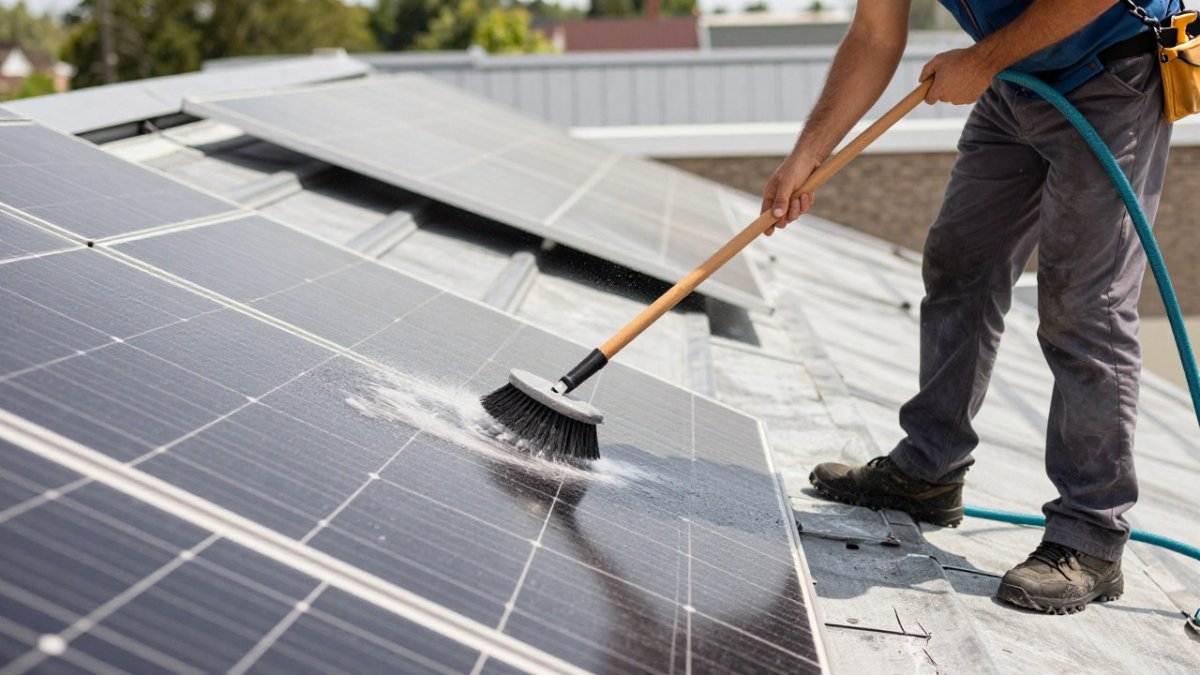
Work from the ground with a long-handled soft brush and a garden hose. Rinse first to float dust off, then brush gently, then rinse again.
Watch out: never stand on the panels themselves. They are not designed to bear weight, and a cracked module means a costly replacement.
Finding a Solar Panel Cleaning Service Near Me: What to Verify
When you search for a solar panel cleaning service near me, verify three things before booking. First, confirm the company is licensed, bonded, and insured. Second, ask what water and tools they use, and whether their method matches your panel maker’s guidance. Third, get a flat written quote.
Insurance matters more than most homeowners realize. If a crew member is injured on your property, a properly insured company protects you from liability. A bonded company also gives you recourse if something goes wrong.
Salt Lake City Window Cleaning has over 15 years of experience as a fully licensed, bonded, and insured team. You can reach our team directly to ask questions or schedule a visit.
Request an Estimate for Solar Panel Cleaning
Cleaning is worth it when the recovered production beats the cost, and that tipping point is different for every roof.
At Salt Lake City Window Cleaning, we handle solar panel cleaning so you get efficient panel operation without ladder risk.
Get started with Salt Lake City Window Cleaning and put a clear, honest number on your panel cleaning. You can request an estimate for solar panel cleaning and schedule around your needs.
Dirty panels quietly cost you output, and guessing about it wastes money either way.
Frequently Asked Questions
Does cleaning solar panels really make a difference?
It can, but the size of the gain depends on how dirty the panels are and what is sitting on them. A light layer of dust usually costs a small percentage of output, while heavy buildup from pollen, bird droppings, or construction dust can cost more. Check your inverter or monitoring app for a drop in kilowatt-hours that lines up with a dusty stretch, then compare the value of that lost production against the cost of cleaning. If the math does not clear the cleaning price, wait.
What is the average cost of solar panel cleaning?
Pricing for solar panel cleaning varies by array size, roof pitch, access, and how much soiling is present, so a phone quote is the only reliable number. Pricing depends on the specifics of your array and job, so request a quote from Salt Lake City Window Cleaning on its website for current prices. Ask for a written quote before the crew arrives, and confirm the provider is licensed, bonded, and insured.
Is it safe to clean solar panels yourself?
You can safely clean panels from the ground with a long-handled soft brush, a garden hose, and plain water. Avoid walking on the roof, avoid abrasive pads and harsh soaps, and never use a pressure washer directly on the glass or the frame seals. Check the manufacturer’s guidance first, because some warranties require certain methods or approved products. If your array is steep, high, or hard to reach, hire a licensed and insured professional rather than risk a fall.
How much energy can dirty solar panels lose?
Losses range widely with local conditions. A light dust film typically causes a small percentage drop, while dense pollen, bird droppings, or leaf litter can block more sunlight and cut output further. Shading from even a few dirty spots can pull down a whole string of photovoltaic panels, so a small soiled area can matter more than it looks. Use your monitoring data to spot a production dip that matches visible soiling before you pay for cleaning.
